
Content
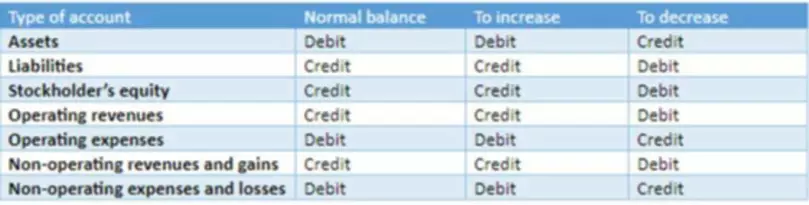
When you debit an account, you must also credit another account. If you’re using the accrual method of accounting for inventory, when you enter a journal entry, you have to keep these two sides in balance by matching debits to credits.

A debit increases the balance of an asset account and decreases the balance of a liability account, while a credit does the opposite. In other words, when you make a journal entry, you are either increasing an asset or decreasing an expense or liability. You are not allowed to increase both at the same time; you must choose one or the other. Contra liability accounts and contra expense accounts—like their contra asset counterparts—also reverse the debit/credit “rules” from the table in the previous section. An addition to a liability account, for instance, is usually a credit, but to a contra liability account, the increase is a debit. For this reason, the balance in a contra liability account is a debit balance. It is different from the single entry accounting system, which involves filling in the information in only one account.
Use accounting software
Hence, the tax authorities trust and accept the method for tax purposes. However, a single entry accounting method is less trusted and not acceptable for tax computation by the authorities. Accounting software usually produces several different types of financial and accounting reports in addition to the balance sheet, income statement, and statement of cash flows. A commonly used report, called the “trial balance,” lists every account in the general ledger that has any activity. Double-entry bookkeeping is usually done using accounting software. The software lets a business create custom accounts, like a “technology expense” account to record purchases of computers, printers, cell phones, etc. You can also connect your business bank account to make recording transactions easier.
What are the 4 parts of a journal entry?
- Date. It means the date on which the transaction has taken place.
- Debit. It is the amount by which accounts are to be debited.
- Credit. It is the amount by which accounts are to be credited.
- Source Document.
You buy a new office chair with your credit card, which has a balance of $2,000 at the time of purchase. The transaction debits your asset account “Office Furniture” for $200 and credits your liability account “Credit Card Balance” for $200 .
Bank and cash transactions
Debits are increases to an account, and credits are decreases to an account. The chart of accounts is a different category group for the financial transactions in your business and is used to generate financial statements. This is reflected in the books by debiting inventory and crediting accounts payable.
In fact, a double-entry bookkeeping system is essential to any company with more than one employee or that has inventory, debts, or several accounts. When you make the payment, your account payable decreases by $780, and your cash decreases by $780. The above becomes clearer when we look at the accounting equation, one of the fundamental principles of accounting. The entry is a debit of $8,000 to the cash account and a credit of $8,000 to the common stock account. You buy $1,000 of goods with the intention of later selling them to a third party. The entry is a debit to the inventory account and a credit to the cash account. Did the first sample transaction follow the double-entry system and affect two or more accounts?
Module 4: Financial Statements of Business Organizations
Making the decision to study can be a big step, which is why you’ll want a trusted University. We’ve pioneered distance learning for over 50 years, bringing university to you wherever you are so you can fit study around your life. Anyone can learn for free on OpenLearn, but signing-up will give you access to your personal learning profile and record of achievements that you earn while you study. When failure is not an double entry accounting option, wise project managers rely on the power of statistical process control to uncover hidden schedule risks, build teamwork, and guarantee on-time delivery. Take control of asset TCO and prevent nasty cost surprises later. Financial Metrics are center-stage in every business, every day. Metrics are crucial for business planning, making informed decisions, defining strategic targets, and measuring performance.
- There are two different ways to record the effects of debits and credits on accounts in the double-entry system of bookkeeping.
- The user must, for instance, have a solid grasp of concepts such as debit, credit, Chart of accounts, and the two Accounting equations.
- A debit is made in at least one account and a credit is made in at least one other account.
- They serve as a key tool for monitoring and tracking the company’s performance and ensuring the smooth operation of the firm.
- This accounting system helps organizations assess their overall performance in a financial year.
- Rely on BC Templates 2021 and win approvals, funding, and top-level support.
A business has assets of £110,000, liabilities of £30,000, income in the year of £20,000 against expenses incurred of £10,000 and capital at the beginning of the year of £70,000. Using the two forms of the accounting equation, insert these figures into each equation to show that the equation holds true in both cases. If instead, the firm finances the purchase with a bank loan, instead of the company’s cash, the offsetting $100,000 transaction could be a credit to a liability account. A credit to a liability account increases the account balance. In accounting, the duality concept, also known as the dual aspect concept, refers to how each transaction made affects a business in two aspects. The double entry accounting method is based on this concept of duality.
How the bookkeeper and accountant handle each transaction for an account depends on which of the five account categories includes the account. Also, whether a debit or a credit increases or decreases the account balance also depends on the account’s category. Exhibit 1 summarizes debit and credit conventions for the five account types. This period saw, for instance, rising levels of international shipping and commerce. Merchants began selling “on credit,” forming partnerships and companies, obtaining funding from private banks, and covering business investments with insurance.
What are 3 types of accounts?
3 Different types of accounts in accounting are Real, Personal and Nominal Account. Real account is then classified in two subcategories – Intangible real account, Tangible real account. Also, three different sub-types of Personal account are Natural, Representative and Artificial.
We’re here to take the guesswork out of running your own business—for good. Your bookkeeping team imports bank statements, categorizes transactions, and prepares financial statements every month. In this case, the asset that has increased in value is your Inventory. Because you bought the inventory on credit, your accounts payable account also increases by $10,000. Single-entry accounting involves writing down all of your business’s transactions (revenues, expenses, payroll, etc.) in a single ledger. If you’re a freelancer or sole proprietor, you might already be using this system right now. It’s quick and easy—and that’s pretty much where the benefits of single-entry end.